Fastest path in
JobOps Cloud
Use the hosted product if you want the shortest route from curiosity to a working setup.
- Managed setup
- No local install
- Start today
Open source job search
Job searching starts as a few saved links. Then it becomes tabs, notes, stale CVs, vanished job posts, recruiter calls you barely remember, and follow-ups you meant to send three days ago.
That mess is not a motivation problem. The hard part is keeping track of what changed.
JobOps keeps that mess in one place: the roles you found, the ones you saved, the resumes you tailored, the applications you sent, and the next steps you do not want to forget.
The parts of job searching that usually live in your browser history, your notes app, your downloads folder, and your memory.
The problem is the mess
The motivation problem is really a context problem.
The mess is the tab switching, the copy-pasting, the rewriting, the lost links.
You find a role on LinkedIn.
You open a doc and start rewriting the same CV again.
You paste the job description into AI.
You export, upload, apply, and forget which version you used.
A week later the posting is gone and the context is half erased.
Two weeks later you are trying to remember what you sent, where, and why.
The fix
A job listing should not just be a link. It should carry the role, company, fit, notes, resume version, status, and next action with it.
That is the point: less lost context, less rereading, less rebuilding from memory.
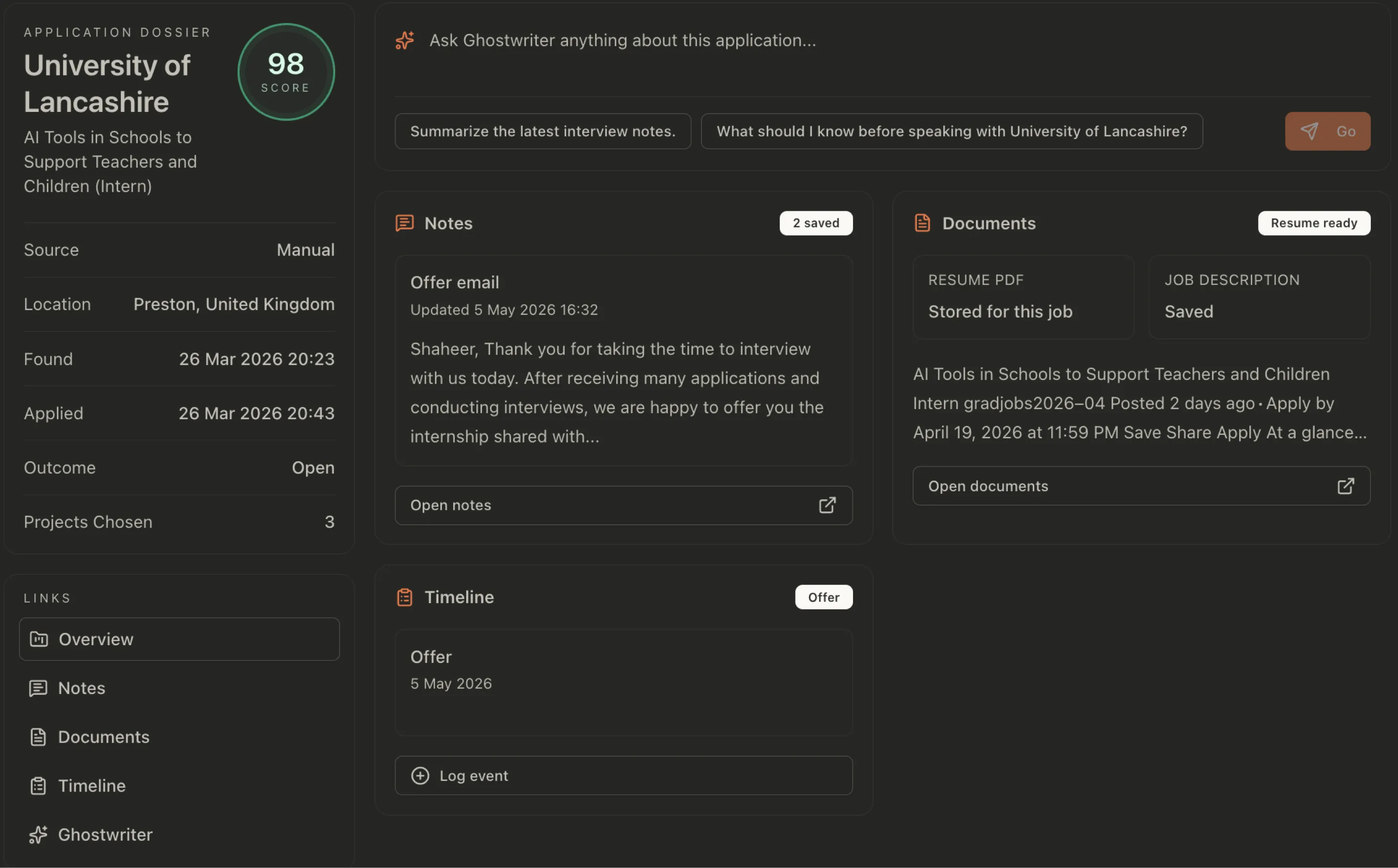
The workflow
All in one place, with you in control.
01
Run dozens of searches across different job boards with one command, and get the results in your workspace without opening a dozen tabs.
02
Save the role before the job post disappears. Keep the description, company, and your notes together, just in case there's a call later.
03
Adjust your resume while the job is still open, so you are not rewriting from memory.
04
Know which CV you sent, what the next step was, and which follow-up you still owe.
That is deliberate.
The answer to a brutal job market is not “send more applications.” It is better search, better fit, better tailoring, and better follow-through.
JobOps keeps the mess around that decision from taking over your patience and your motivation.
JobOps is built to speed up the human part of the search, not replace it.
You still decide what is worth applying to, because only you know the context that goes into that decision
Why open source?
A lot of job search tools are priced like the person using them already has a comfortable income. That feels backwards.
Job seekers are often students, laid-off workers, immigrants, new grads, career switchers, or people trying to get out of a bad situation. Charging them heavy monthly SaaS prices just to stay organised feels wrong.
JobOps is open source because the core workflow should be available to anyone willing to set it up.
If you want the cheapest path, self-host it for free.
If you want the fastest path, use JobOps Cloud and let us run it for you.
Same workflow. Different trade-off.
Proof
JobOps grew because people recognised the pain. Developers starred it, job seekers tried it, and an open-source ecosystem formed around one idea: job searching needs better tools, for free.
The numbers matter less than the response: people felt the same mess and wanted a better way through it.
I've been using job-ops almost daily. It's helped me stay on top of applications, tailor my resume, and keep everything organised. It takes a lot of the chaos out of job searching and makes the process feel way more structured.
Run it yourself, or let us run it for you
Choose the hosted version if you want it running now, or self-host if you want the stack in your hands.
Fastest path in
Use the hosted product if you want the shortest route from curiosity to a working setup.
Full control
Run the open-source stack yourself if privacy, customization, or ownership matters more than convenience.
A few practical questions
JobOps is the open-source workspace for running a serious job search. It helps you search roles, save the right ones, tailor your resume, and track every application from one place.
Yes. You can inspect it, fork it, and self-host it if you want full control over how the workflow runs.
No. JobOps is deliberately not an auto-apply bot. It helps you make better decisions and removes the repetitive mess around those decisions.
Yes. Self-hosting is available if you want ownership, privacy, or a more custom setup.
JobOps Cloud is the fastest way to get started. Self-hosted JobOps gives you more control and flexibility if you want to run the stack yourself.
JobOps is for serious job seekers who want a better process, especially if they are juggling multiple applications and tailoring often.
Yes. The workflow is global. Pricing and launch details can vary, but the product is not limited to the UK.
Final step
Give your job search a place to live. Search, save, tailor, track, and keep the human in it.